Have you ever wondered why some antennas claim to have “gain” while others don’t? It sounds like magic, but in the ham radio world, it’s actually all about how you focus your energy.
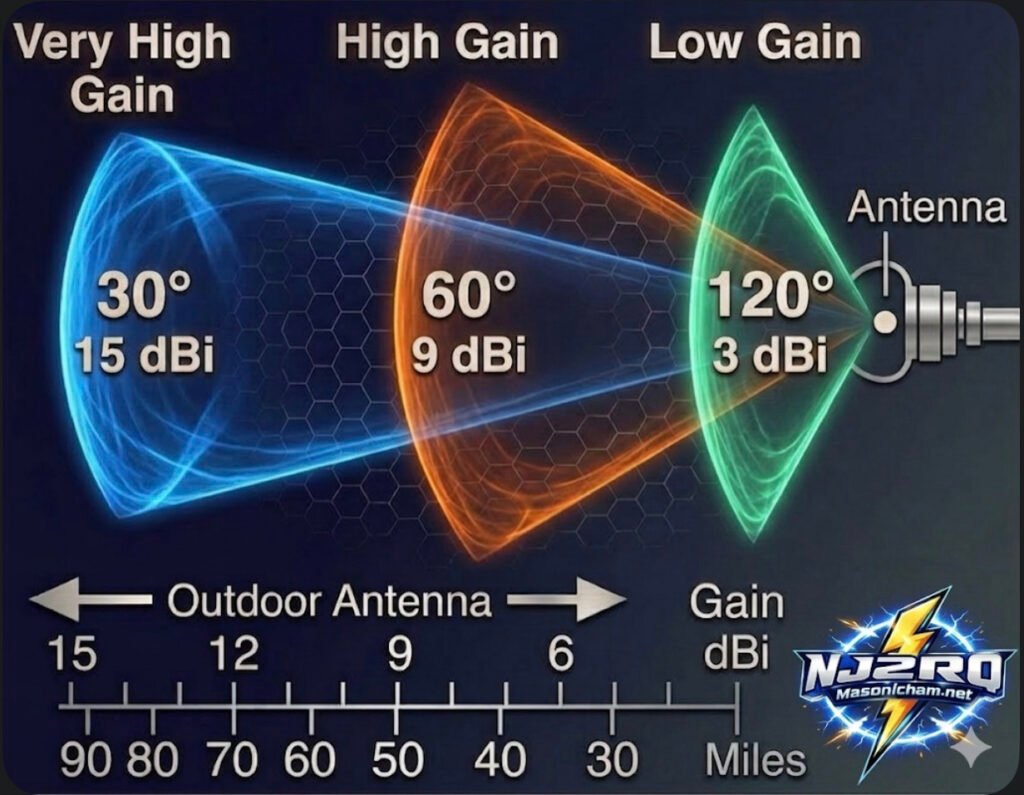
Check out this new card I put together to help visualize how it works:
The Big Secret: It’s Not an Amplifier!
Here is the most important thing to remember: with any antenna, the apparent increase in signal is not actually an amplification of the signal. Antennas are passive, meaning they don’t have a power plug to create more energy.
Instead, gain is simply the act of redistributing the available Radio Frequency (RF) signal into a preferred direction. Think of it like a flashlight: the bulb stays the same brightness, but the reflector concentrates all that light into a tight beam so you can see much further. Basically, antennas only divert, direct, or concentrate radio energy; they don’t create it.
Understanding the Trade-off
As you can see on the card, there is always a “give and take”:
Low Gain (3 dBi): You get a very wide coverage area (120°), but your signal doesn’t travel as many miles. Great for local ragchews!
High Gain (9 dBi): The beam narrows down to 60°. You lose some side coverage, but you gain a lot of distance—reaching out to about 50 miles in this example.
Very High Gain (15 dBi): This is a “laser beam” at 30°. It’s perfect for DXing (long-distance) because it concentrates your signal to reach 90 miles or more, but you have to point it exactly at the other station!
Pro Tip for the Shack: When you see a gain rating in dBi, it’s comparing the antenna to an “Isotropic” source (an imaginary point that radiates equally in every single direction like a perfect sphere). When you’re picking a Yagi or a directional wire antenna, remember that a higher gain number means you’re “squeezing” your signal into a tighter spot to reach further away!
What’s your go-to antenna for reaching those far-off DX stations? Do you prefer a wide “floodlight” or a narrow “spotlight”? Let me know in the comments!