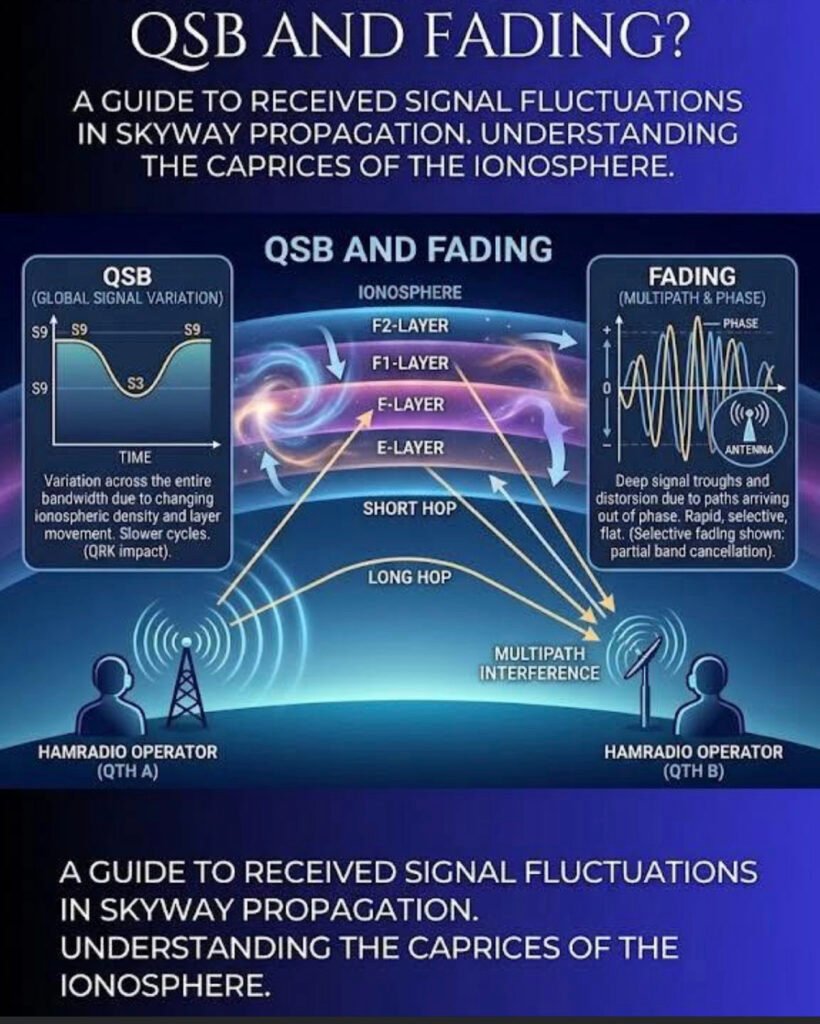
If you’ve spent any time on the high-frequency (HF) bands, you know the ionosphere is far from a stable mirror. It’s more like a moving, shimmering curtain. This graphic perfectly illustrates the two main ways that “shimmer” affects your signal: Global Signal Variation (QSB) and Multipath Interference (Fading).
1. QSB: The Slow Roller
In the left panel, we see QSB (a Q-code used to describe signal strength variation).
• What it is: A global change in signal intensity across your entire bandwidth.
• The Cause: As the sun’s radiation fluctuates or the density of the ionospheric layers (E, F1, F2) shifts, the “reflectivity” of the sky changes.
• The Effect: You’ll notice your S-meter moving from an S9 down to an S3 and back again over a period of seconds or even minutes. It’s a slow, rhythmic cycle that affects the whole signal equally.
2. The Ionospheric Layers: The “Bounce” House
The center of the image shows the Short Hop and Long Hop propagation.
• F2-Layer: Usually the highest and most important for long-distance (DX) communication.
• E-Layer: Lower down, often responsible for “Short Skip” or Sporadic-E openings.
The signal doesn’t just hit one spot; it can take multiple paths to reach the receiving station (QTH B).
3. Fading: The Phase Killer
The right panel highlights Fading, which is often much more “violent” and rapid than standard QSB.
• The Cause (Multipath Interference): Your signal travels via different paths—one might bounce off the F2 layer while another bounces off the E layer. Because these paths are different lengths, the signals arrive at the receiving antenna at slightly different times.
• The Result: When these signals meet, they can be out of phase. If the peak of one wave hits the trough of another, they cancel each other out.
• The Sound: This results in “selective fading,” where the audio might sound hollow, distorted, or watery. It’s not just getting quieter; the signal itself is being mangled in real-time.
The Takeaway for Operators
When you hear a signal “pumping” or distorting, you’re hearing the literal movement of the atmosphere miles above the Earth. While we can’t change the ionosphere, understanding these fluctuations helps us better time our transmissions and adjust our expectations for that rare DX contact.