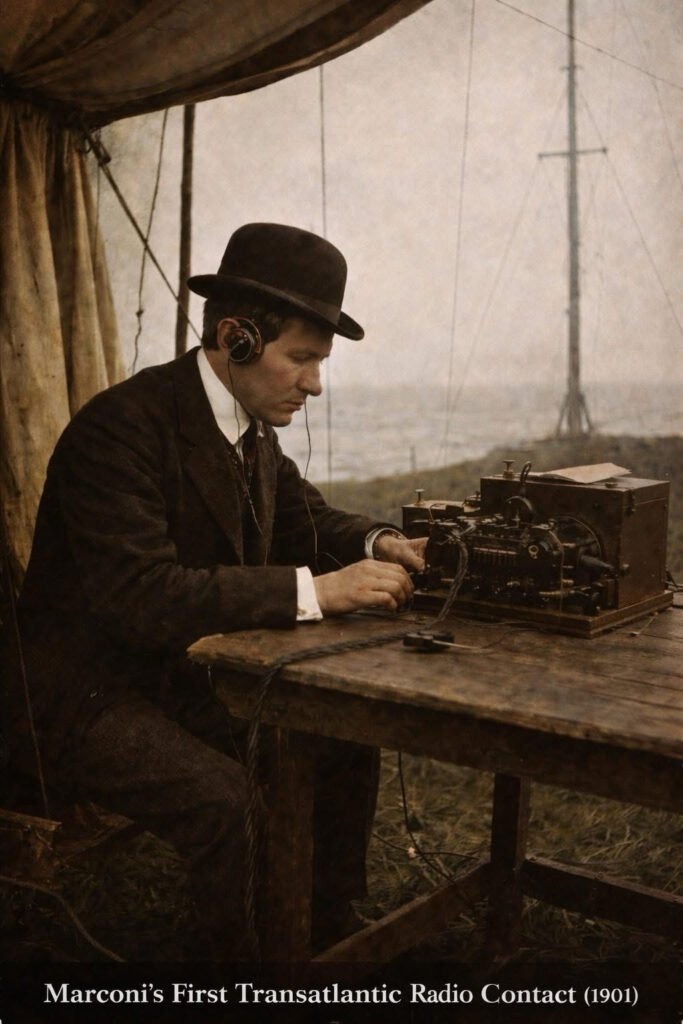
December 12, 1901. A cold, windswept cliff in Newfoundland, Canada.
Guglielmo Marconi sat in a tent — headphones on, listening for something many believed simply wouldn’t work.
Then he heard it.
Three faint dots. ···
The letter “S” in Morse code.
Transmitted from Poldhu, Cornwall, England — over 2,000 miles across the Atlantic.
No wire. No cable. Just invisible waves crossing an ocean.
Many scientists had doubted it would work. The Earth is curved, they argued. Radio waves travel in straight lines. They’ll shoot off into space and disappear.
Marconi was 27 years old. He pressed forward anyway.
What Marconi didn’t fully understand — and what science would later prove — was that the ionosphere reflects radio waves back to Earth. Nature itself was the relay station. He didn’t know why it worked. He just proved that it did.
But Marconi wasn’t finished.
On the windswept shores of Cape Cod, Massachusetts, he constructed one of the most powerful wireless stations on Earth — four towering 210-foot wooden masts rising from the sand dunes of South Wellfleet.
On January 19, 1903, that station made history again.
President Theodore Roosevelt and King Edward VII exchanged the first transatlantic wireless messages between world leaders — proof that this was no longer just a scientific experiment. It was the dawn of global communication.
The site still exists today. The structures are long gone — lost to time and storms — but you can still walk those dunes and feel the weight of what happened there.
Two stations. Two milestones. One unstoppable vision.
And that vision is the grandfather of everything we do today.
🔹 Every DX contact you’ve ever logged
🔹 Every emergency net that saved lives
🔹 Every moonbounce, satellite pass, and digital mode
🔹 Every “59, you’re making it here from across the world”
It all started with three dots in a freezing tent.
Ham radio didn’t just survive 125 years. It evolved, adapted, and thrived — because the magic Marconi stumbled into that December morning never gets old.
The ionosphere is still up there.