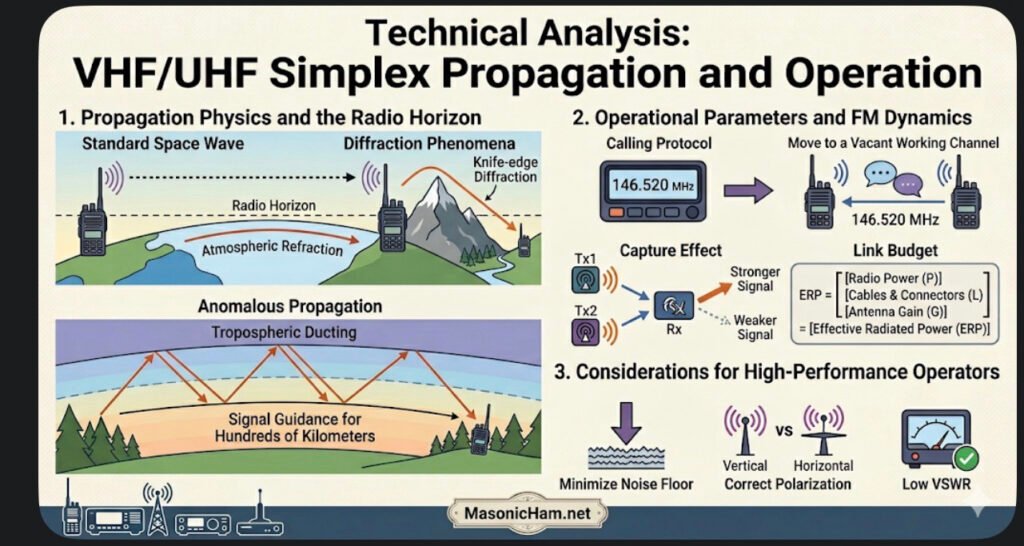
Simplex operation represents the fundamental Single-Frequency Half-Duplex communication mode. Unlike duplex systems that utilize frequency offsets and repeaters, simplex relies entirely on the direct link between two stations. This makes it the ultimate test of a radiant system’s efficiency and the operator’s mastery of the local RF environment.
- Propagation Physics and the Radio Horizon
In the VHF and UHF bands, communication is primarily governed by line-of-sight space wave propagation.
✔️Atmospheric Refraction: The radio horizon is slightly longer than the visual horizon. This occurs because variations in atmospheric density cause radio waves to undergo a subtle curvature, allowing the signal to follow the Earth’s curvature for an additional distance.
✔️Diffraction Phenomena: Success in simplex within obstructed areas depends on knife-edge diffraction, where the signal “bends” upon hitting sharp obstacles such as mountain ridges or the tops of buildings.
✔️Anomalous Propagation: Events such as tropospheric ducting, caused by thermal inversions, can create atmospheric layers that guide the signal for hundreds of kilometers, enabling simplex contacts that would be impossible under normal conditions.
- Operational Parameters and FM Dynamics
✔️Calling Protocol: The 146.520 MHz frequency acts as a meeting point. Standard operational protocol dictates that, after initial contact, operators should move to a vacant working channel, preserving the calling frequency for new requests.
✔️Capture Effect: A vital characteristic of the FM mode in simplex is the capture effect. The receiver will process only the signal that arrives with the highest intensity, suppressing weaker signals on the same frequency. This requires technical coordination to prevent more powerful stations from “clobbering” ongoing communications.
✔️Link Budget: Without the gain of a repeater, performance depends exclusively on Effective Radiated Power (ERP). This is the result of the actual power leaving the radio, subtracting attenuation losses in cables and connectors, and adding the directional gain of the antenna used.
- Considerations for the High-Performance Operator
Advanced simplex operation requires minimizing the Noise Floor. In point-to-point scenarios, the Signal-to-Noise Ratio is the determining factor. Using the correct polarization (generally vertical for mobile stations and horizontal for sideband DX) and ensuring a low Voltage Standing Wave Ratio (VSWR) are fundamental to guaranteeing communication integrity at extreme distance limits.
73