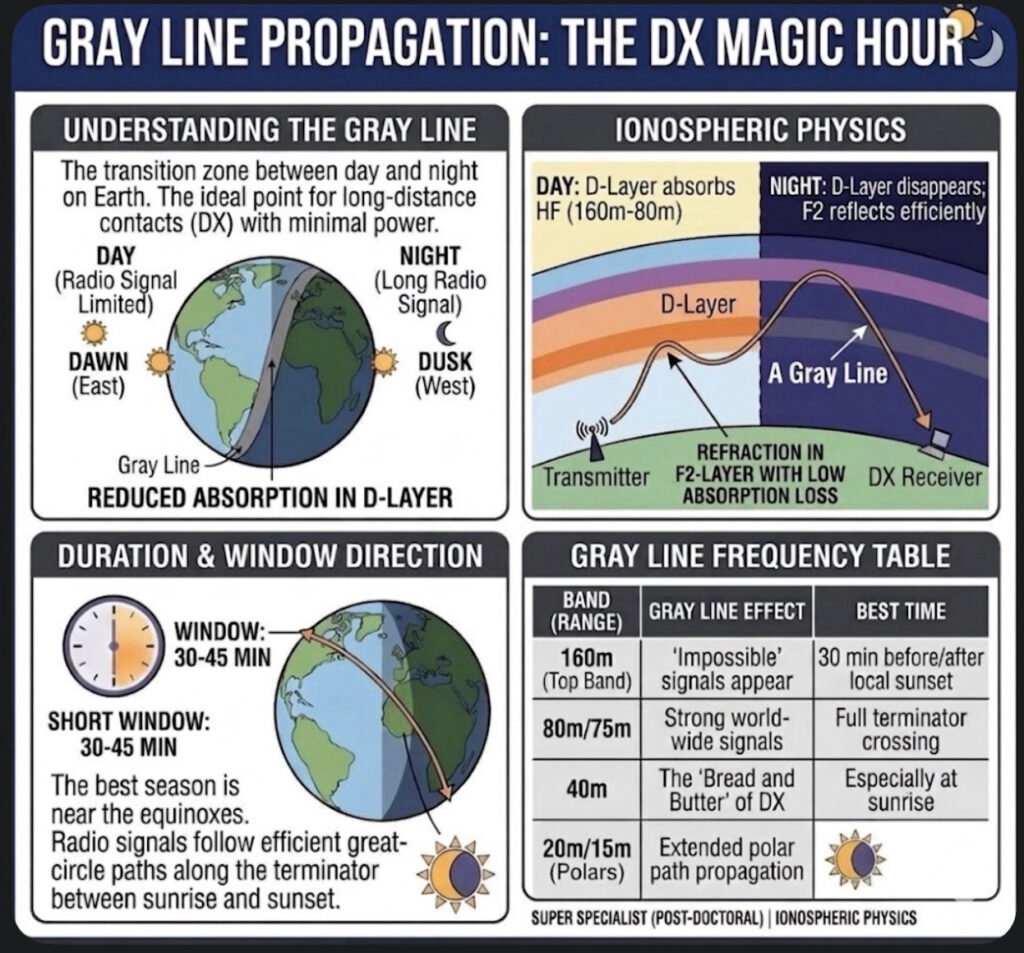
If you’ve ever been on the air around sunset or sunrise and noticed signals from the other side of the planet suddenly booming in—as if someone flipped a secret switch—you’ve experienced the Gray Line. In the ham radio world, we call this the “DX Magic Hour,” and for good reason. It’s that brief, 30-to-45-minute window where the rules of physics seem to bend in our favor.
But what’s actually happening up there in the ionosphere?
The Science of the “Exterminator”
The Gray Line is essentially the Terminator—the moving boundary that separates day from night. The magic happens because of a perfect atmospheric “hand-off.” During the day, the D-Layer is the enemy of low-band DX; it sits low in the atmosphere and gobbles up your signals on 160m, 80m, and 40m.
As the sun sets, the D-Layer disappears almost instantly because it needs direct sunlight to stay ionized. However, the higher F2-Layer is much thinner and takes a lot longer to lose its charge. For a short time, you have a clear path where your signal can bounce (refract) off the F2-Layer with almost zero absorption from the D-Layer. It’s like a high-speed tunnel for radio waves.
How to Ride the Wave
As you can see on the card I put together, the signals follow Great Circle paths along this twilight zone. This isn’t just for the “Top Band” (160m) enthusiasts.
On 40m: This is the “bread and butter” of Gray Line work. You can often work stations halfway around the world with surprisingly low power.
On 160m and 80m: You’ll hear “impossible” signals. If you’re in South America at sunset, you might find yourself talking to someone in Asia who is just seeing their sunrise.
On 20m and 15m: It opens up unique polar paths that are usually closed during the dead of night or the heat of the day.
Tips for the Shack
The window is short, so you have to be ready. I always recommend using a real-time Gray Line map or a tool like VOACAP. The peak usually hits when both you and the DX station are sitting right on that terminator line. You’ll hear the noise floor drop, the signals rise, and for a few minutes, the world feels a lot smaller.
Next time you see the sky turning that deep orange or purple, don’t just admire the view—get on the rig. The Gray Line is nature’s own signal booster, and it’s waiting for you to jump in.