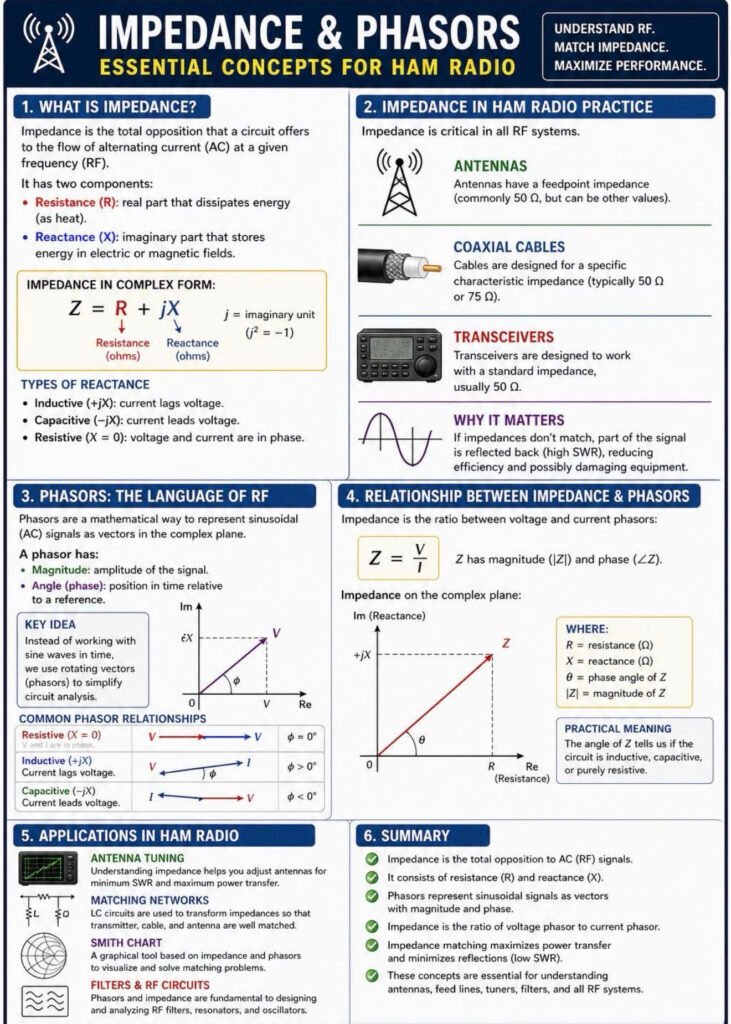
If you’ve ever tried to tune an antenna or wondered why your radio isn’t delivering full power to the air, you’ve already bumped into impedance—even if you didn’t call it that. In simple terms, impedance is how a circuit “pushes back” against an RF signal. It’s not just plain resistance. It also includes effects from capacitors and inductors, which store and release energy as the signal alternates. That’s why, in radio work, impedance is treated as a combination of a real part (which dissipates power) and a reactive part (which shifts energy back and forth). This idea is standard in basic circuit theory and RF engineering references like ARRL handbooks and classic textbooks.
Now, where things get interesting is when signals are constantly changing, like they do in radio. Instead of tracking every rise and fall of a sine wave over time, engineers use a shortcut called phasors. Think of a phasor as a rotating arrow that represents the signal’s size and its timing (phase) all at once. This approach is widely used in electrical engineering because it makes analyzing AC circuits much easier, especially when you’re dealing with filters, amplifiers, or antennas.
So how do these two ideas connect in real ham radio practice? Impedance depends on how voltage and current relate to each other, and in RF circuits they’re often not perfectly “in sync.” That phase difference—whether current lags or leads voltage—is exactly what phasors help visualize. For example, an inductive load causes current to lag behind voltage, while a capacitive load does the opposite. These behaviors are well established in standard AC circuit analysis and are critical when working with tuned circuits or matching networks.
Bringing this back to your shack: when your antenna system is properly matched—typically to 50 ohms for most transceivers—power flows efficiently from the radio into the antenna. If the impedance doesn’t match, part of that signal reflects back, increasing SWR and reducing performance. That’s why understanding impedance and using tools that rely on phasor concepts—like antenna analyzers—makes such a big difference in getting the most out of your station.
Once you see impedance as more than just a number, and phasors as a practical way to understand signal behavior, a lot of RF concepts start to click. It’s not abstract math—it’s exactly what’s happening every time you key the mic.
73