Antenna Basics Frequency
Frequency is one of the most important concepts in the universe and to antenna theory, which we will see. But fortunately, it isn’t too complicated.
Beginner Level (or preliminaries):
Antennas function by transmitting or receiving electromagnetic (EM) waves. Examples of these electromagnetic waves include the light from the sun and the waves received by your cell phone or radio. Your eyes are basically “receiving antennas” that pick up electromagnetic waves that are of a particular frequency. The colors that you see (red, green, blue) are each waves of different frequencies that your eyes can detect.
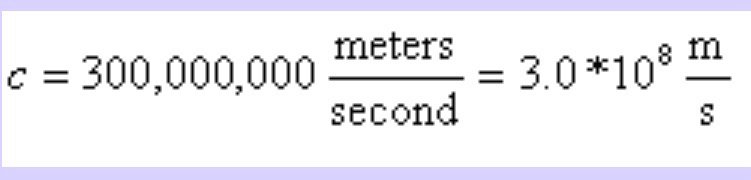
All electromagnetic waves propagate at the same speed in air or in space. This speed (the speed of light) is roughly 671 million miles per hour (1 billion kilometers per hour). This is roughly a million times faster than the speed of sound (which is about 761 miles per hour at sea level). The speed of light will be denoted as c in the equations that follow. We like to use “SI” units in science (length measured in meters,time in seconds,mass in kilograms), so we will forever remember that
Before defining frequency, we must define what a “electromagnetic wave” is. This is an electric fieldthat travels away from some source (an antenna, the sun, a radio tower, whatever). A traveling electric field has an associated magnetic field with it, and the two make up an electromagnetic wave.
The universe allows these waves to take any shape. The most important shape though is the sinusoidal wave, which is plotted in Figure 1. EM waves vary with space (position) and time. The spatial variation is given in Figure 1, and the the temporal (time) variation is given in Figure 2.
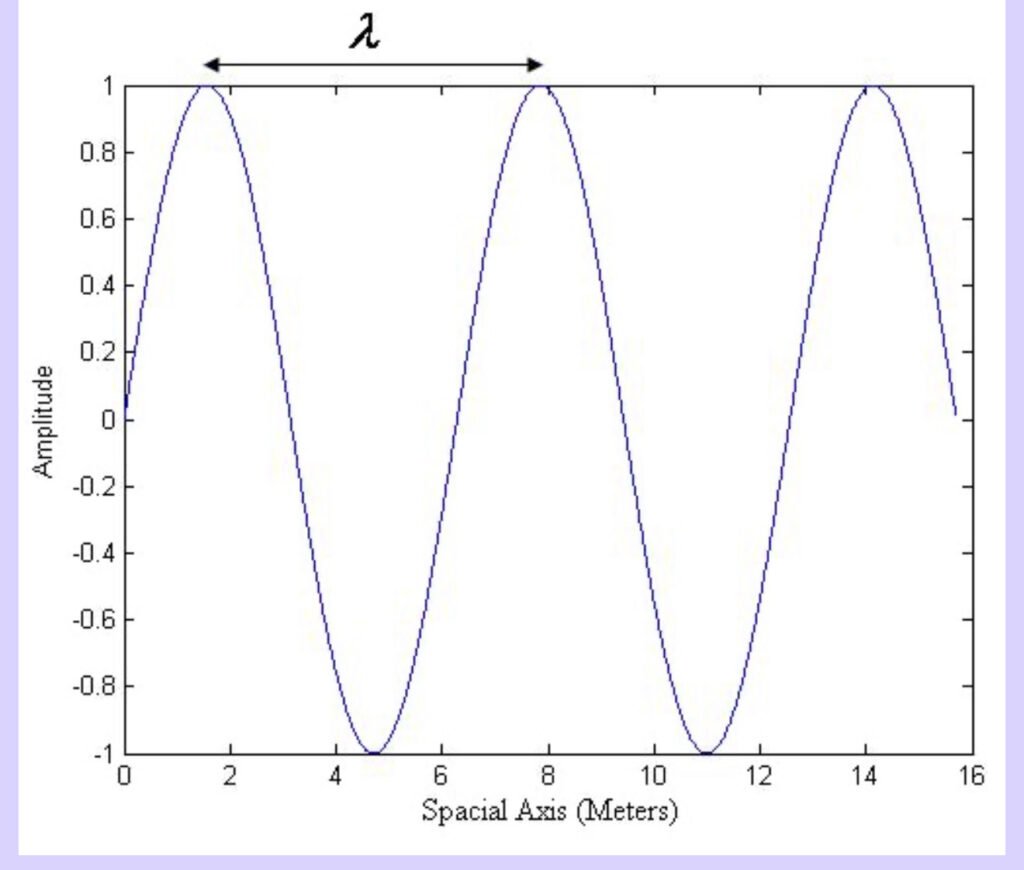
Figure 1. A Sinusoidal Wave plotted as a function of position
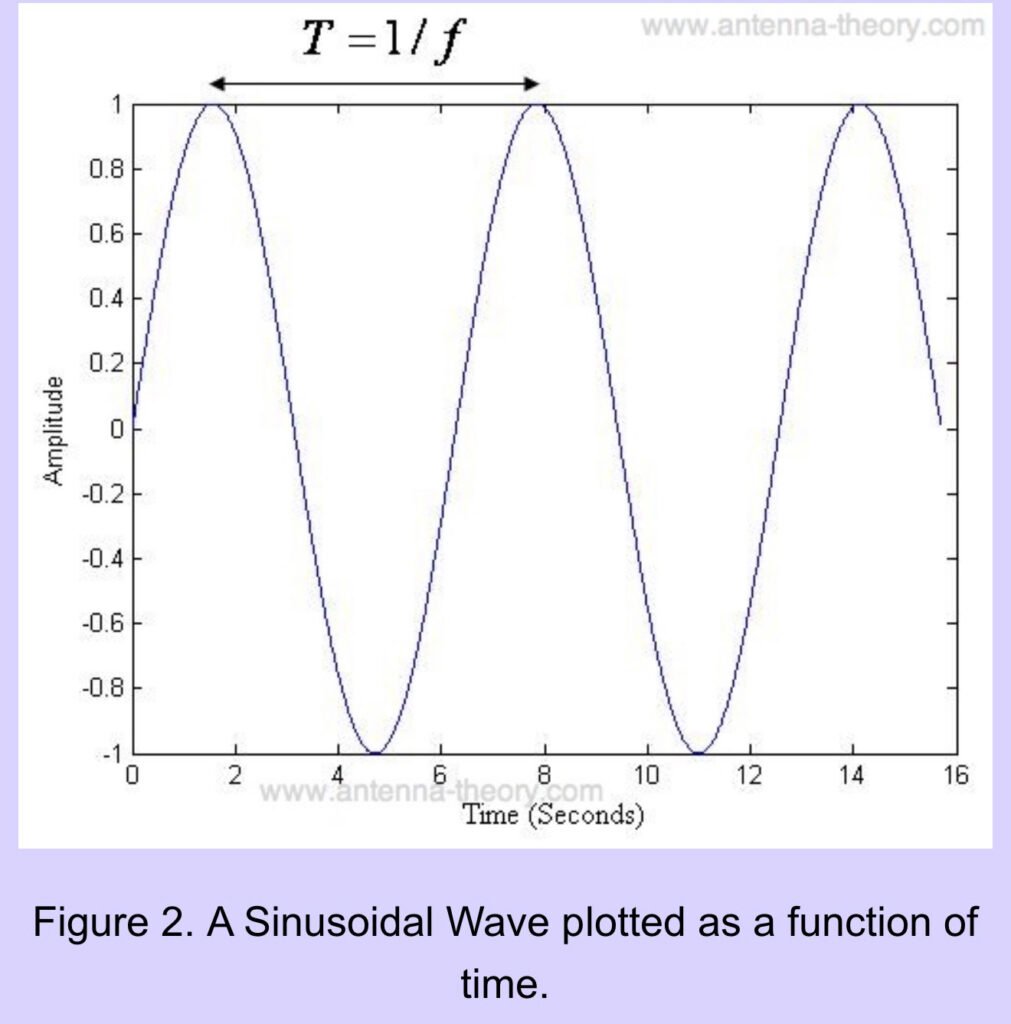
The wave is periodic, it repeats itself every T seconds. Plotted as a function in space, it repeats itself every

meters, which we will call the wavelength. The frequency (written f ) is simply the number of complete cycles the wave completes (viewed as a function of time) in one second (two hundred cycles per second is written 200 Hz, or 200 “Hertz”). Mathematically this is written as:
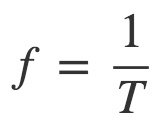
How fast someone walks depends on the size of the steps they take (the wavelength) multipled by the rate at which they take steps (the frequency). The speed that the waves travel is how fast the waves are oscillating in time (f ) multiplied by the size of the step the waves are taken per period (
). The equation that relates frequency, wavelength and the speed of light can be tattooed on your forehead:
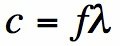
Basically, the frequency is just a measure of how fast the wave is oscillating. And since all EM waves travel at the same speed, the faster it oscillates the shorter the wavelength. And a longer wavelength implies a slower frequency.
Why is frequency so fundamental? To really understand that, we must introduce one of the coolest mathematical ideas ever (seriously), and that is ‘Fourier Analysis’. I had a class on Fourier Analysis in grad school at Stanford University, and the professor referred to these concepts as ‘one of the fundamental secrets of the universe’.
Let’s start with a question. What is the frequency of the following waveform?
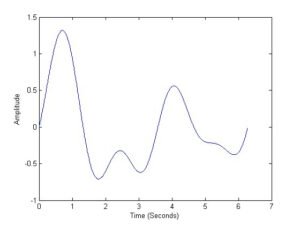
All waveforms, no matter what you scribble or observe in the universe, are actually just the sum of simple sinusoids of different frequencies
As an example, lets break down the waveform in Figure 1 into its ‘building blocks’ or the it’s frequencies. This decomposition can be done with a Fourier transform (or Fourier series for periodic waveforms).
The first component is a sinusoidal wave with period T=6.28 (2*pi) and amplitude 0.3, as shown in Figure 2.
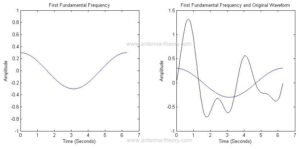
The second frequency will have a period half as long as the first (twice the frequency). The second component is shown on the left in Figure 3, along with the sum of the first two frequencies compared to the original waveform.
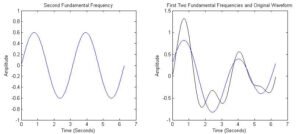
We see that the sum of the first two frequencies is starting to look like the original waveform. The third frequency component is 3 times the frequency as the first. The sum of the first 3 components are shown in Figure 4.
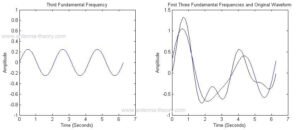
Finally, adding in the fourth frequency component, we get the original waveform, shown in Figure 5.
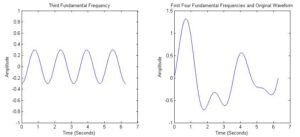
While this seems made up, it is true for all waveforms. This goes for TV signals, cell phone signals, the sound waves that travel when you speak. In general, waveforms are not made up of a discrete number of frequencies, but rather a continuous range of frequencies.
Hence, for all of antenna theory, we will be discussing wavelength or frequency as a key parameter. Actual antennas radiate real world signals – data from the internet over WIFI, speech signals, etc etc etc. However, since every piece of information in the universe can be decomposed into sine and cosine components of varying frequencies, we always discuss antennas in terms of the wavelength it operates at or the frequency we are using.
As a further consequence of this, the power an antenna can transmit is divided into frequency regions, or frequency bands. In the next section, we’ll look at what we can say about these frequency bands.
How can your cell phone and your television work at the same time? Both use antennas to receive information from electromagnetic waves, so why isn’t there a problem?
The answer goes back to the fundamental secret of the universe. No matter what information you want to send, that waveform can be represented as the sum of a range of frequencies. By the use of modulation (which in a nutshell shifts the frequency range of the waveform to be sent to a higher frequency band), the waveforms can be relocated to separate frequency bands.
As an example, cell phones that use the PCS (Personal Communications Service) band have their signals shifted to 1850-1900 MHz. Television is broadcast primarily at 54-216 MHz. FM radio operates between 87.5-108 MHz.
The set of all frequencies is referred to as “the spectrum”. Cell phone companies have to pay big money to get access to part of the spectrum. For instance, AT&T has to bid on a slice of the spectrum with the FCC, for the “right” to transmit information within that band. The transmission of EM energy is greatly regulated. When AT&T is sold a slice of the spectrum, they can not transmit energy at any other band (technically, the amount transmitted must be below some threshold in adjacent bands).
The Bandwidth of a signal is the difference between the signals high and low frequencies. For instance, a signal transmitting between 40 and 50 MHz has a bandwidth of 10 MHz. This means that the energy of the signal is contained between 40 and 50 MHz (and the energy in any other frequency range is negligible).
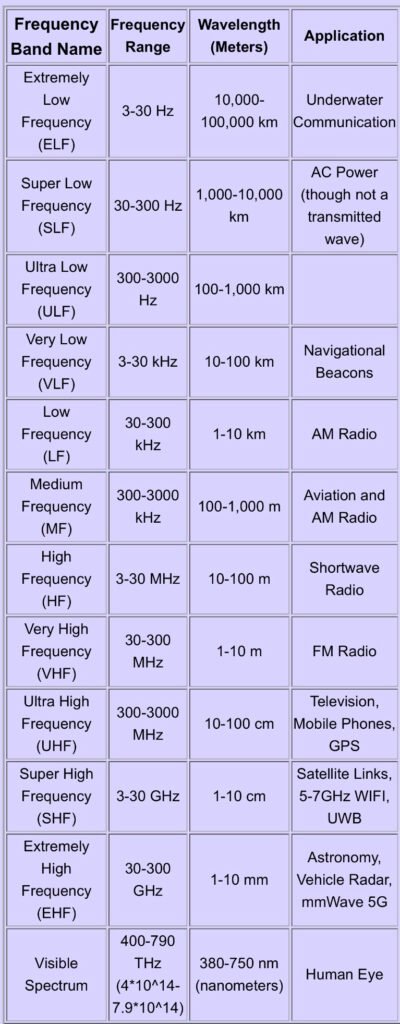
We’ll wrap up with a table of frequency bands along with the corresponding wavelengths. From the table, we see that VHF is in the range 30-300 MHz (30 Million-300 Million cycles per second). At the very least then, if someone says they need a “VHF antenna”, you should now understand that the antenna should transmit or receive electromagnetic waves that have a frequency of 30-300 MHz.